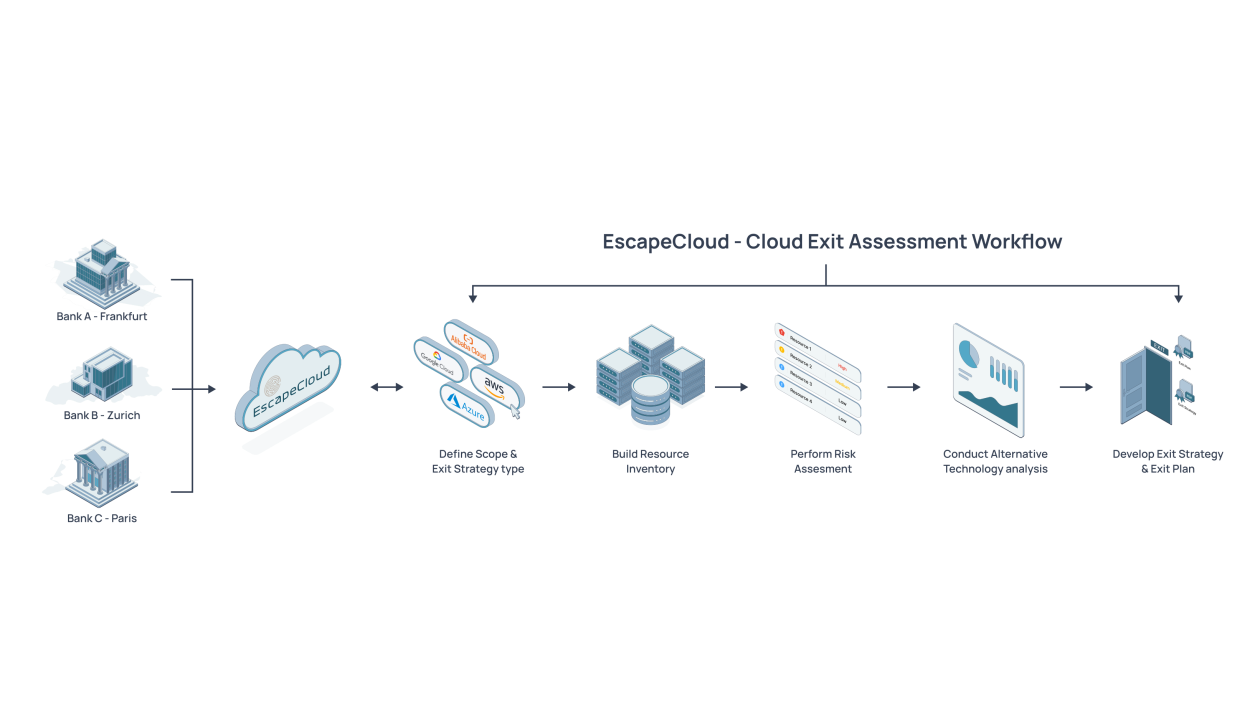

Over the past several years, cloud adoption has accelerated across nearly every industry. Organizations increasingly rely on cloud-native platforms, managed infrastructure services, distributed architectures, and third-party operational ecosystems to support critical business operations.
While these technologies provide scalability and agility, they also introduce new operational considerations related to:
- dependency visibility,
- workload portability,
- operational continuity,
- and infrastructure concentration risk.
As cloud environments continue growing in complexity, organizations are increasingly recognizing that cloud exit readiness is not solely a migration concern. It is becoming an important part of broader operational resilience and governance discussions.
Structured cloud exit readiness initiatives help organizations improve visibility into:
- cloud dependencies,
- infrastructure complexity,
- migration feasibility,
- portability limitations,
- and operational exposure.
This visibility enables organizations to make more informed long-term infrastructure decisions while strengthening resilience planning capabilities.
Table of Contents
ToggleCloud Exit Readiness Is Becoming a Strategic Capability
Historically, cloud exit planning was often treated as a reactive exercise conducted only when major migration initiatives or provider changes became necessary.
Today, this perspective is changing.
Organizations increasingly recognize that cloud exit readiness supports:
- operational resilience,
- strategic flexibility,
- governance maturity,
- and long-term infrastructure adaptability.
Modern cloud environments frequently involve:
- managed Kubernetes platforms,
- provider-native APIs,
- serverless services,
- distributed operational tooling,
- AI and analytics platforms,
- and tightly integrated cloud ecosystems.
Over time, these environments can create operational dependencies that may increase migration complexity and reduce portability flexibility.
As a result, organizations are increasingly seeking structured approaches that improve:
- dependency awareness,
- workload classification,
- operational visibility,
- and migration preparedness.
Cloud exit readiness therefore becomes less about leaving the cloud entirely and more about maintaining flexibility, resilience, and operational control.
Strengthening Operational Visibility and Dependency Awareness
One of the most important aspects of cloud exit readiness is understanding the operational landscape of the environment itself.
Many organizations struggle with:
- incomplete infrastructure visibility,
- undocumented dependencies,
- fragmented operational ownership,
- and rapidly evolving cloud-native architectures.
Structured assessment methodologies help organizations improve visibility into:
- workloads,
- infrastructure composition,
- cloud service usage,
- operational interdependencies,
- and concentration exposure.
This often begins through:
- resource inventory analysis,
- dependency mapping,
- workload classification,
- and operational risk evaluation.
Improved operational visibility enables organizations to better understand:
- which services are business-critical,
- where operational dependencies exist,
- how workloads interact,
- and which areas may introduce migration or resilience challenges.
This level of visibility supports not only cloud exit planning, but also:
- operational continuity initiatives,
- resilience testing,
- governance reviews,
- and strategic infrastructure planning.
Supporting Operational Resilience and Governance Objectives
Operational resilience has become a growing priority across many industries, particularly within financial services and other regulated sectors.
Regulatory frameworks such as:
- the Digital Operational Resilience Act (DORA),
- European Banking Authority (EBA) guidance,
- and broader ICT governance expectations
increasingly encourage organizations to improve:
- third-party dependency awareness,
- contingency planning capabilities,
- workload portability,
- and operational continuity readiness.
Structured cloud exit readiness assessments support these objectives by helping organizations:
- identify provider concentration risks,
- understand operational dependencies,
- evaluate migration complexity,
- and improve visibility into critical ICT services.
This allows organizations to strengthen:
- governance maturity,
- operational preparedness,
- audit readiness,
- and resilience planning capabilities.
Importantly, operational resilience is no longer viewed purely as a compliance exercise. It is increasingly recognized as a long-term operational capability that supports business continuity and strategic flexibility.
Managing Migration Complexity and Financial Exposure
Cloud exit planning also requires organizations to evaluate the financial and operational implications of migration scenarios.
Modern cloud environments frequently contain:
- large-scale operational datasets,
- distributed storage systems,
- managed infrastructure services,
- and significant data transfer requirements.
Organizations therefore increasingly need visibility into:
- migration feasibility,
- data gravity considerations,
- egress fee exposure,
- operational downtime risks,
- and workload transition complexity.
Structured assessment methodologies can help organizations:
- improve financial forecasting,
- identify operational bottlenecks,
- evaluate workload portability,
- and prioritize migration planning activities.
Understanding these factors early helps reduce uncertainty and supports more informed infrastructure decision-making.
Improving Readiness Through Structured Assessment Methodologies
Traditional assessment approaches often relied heavily on:
- manual documentation,
- spreadsheet-driven inventories,
- consultant-led workshops,
- and point-in-time reviews.
However, modern cloud-native environments evolve rapidly through:
- infrastructure-as-code deployments,
- CI/CD pipelines,
- Kubernetes orchestration,
- cloud-native automation,
- and distributed operational teams.
As a result, organizations increasingly require more continuous and structured approaches to cloud exit readiness.
Automated and structured methodologies can help improve:
- inventory accuracy,
- dependency visibility,
- workload analysis,
- operational consistency,
- and resilience planning capabilities.
Importantly, structured assessments do not replace operational expertise.
Instead, they help organizations:
- reduce manual overhead,
- improve visibility,
- strengthen governance processes,
- and support more informed strategic planning.
Cloud Exit Readiness Is Not Anti-Cloud
Cloud exit readiness is sometimes misunderstood as opposition to cloud adoption.
In reality, many organizations continue expanding their cloud usage while simultaneously improving:
- portability awareness,
- dependency visibility,
- operational resilience,
- and strategic flexibility.
Cloud exit readiness complements cloud transformation initiatives by helping organizations better understand:
- operational exposure,
- workload dependencies,
- migration complexity,
- and long-term resilience considerations.
This enables organizations to maintain greater control over their infrastructure strategy while reducing the risks associated with concentrated provider dependency.
Ultimately, cloud exit readiness supports more mature and sustainable cloud governance practices.
Looking Ahead
As cloud ecosystems continue evolving, organizations increasingly recognize the importance of:
- operational visibility,
- dependency awareness,
- workload portability,
- and resilience-oriented infrastructure planning.
Structured cloud exit readiness methodologies are becoming an increasingly important part of these broader governance discussions.
Rather than focusing solely on hypothetical migration scenarios, organizations are using structured assessments to:
- improve operational understanding,
- strengthen resilience maturity,
- identify dependency exposure,
- and support long-term infrastructure adaptability.
As regulatory expectations and cloud-native complexity continue increasing, cloud exit readiness will likely become an essential component of modern operational resilience strategy.
Conclusion
Cloud adoption continues to provide significant operational and technological advantages for organizations worldwide.
However, as cloud environments become increasingly interconnected and operationally complex, organizations also require stronger visibility into:
- dependencies,
- workload portability,
- migration complexity,
- operational concentration,
- and resilience readiness.
Structured cloud exit readiness initiatives help organizations improve:
- operational awareness,
- governance maturity,
- infrastructure flexibility,
- and long-term resilience capabilities.
As operational resilience and cloud governance continue evolving, cloud exit readiness is increasingly becoming an important strategic capability for organizations seeking greater operational control, adaptability, and long-term infrastructure resilience.